
Xiangyunsha: The Ancient Silk Heritage of China
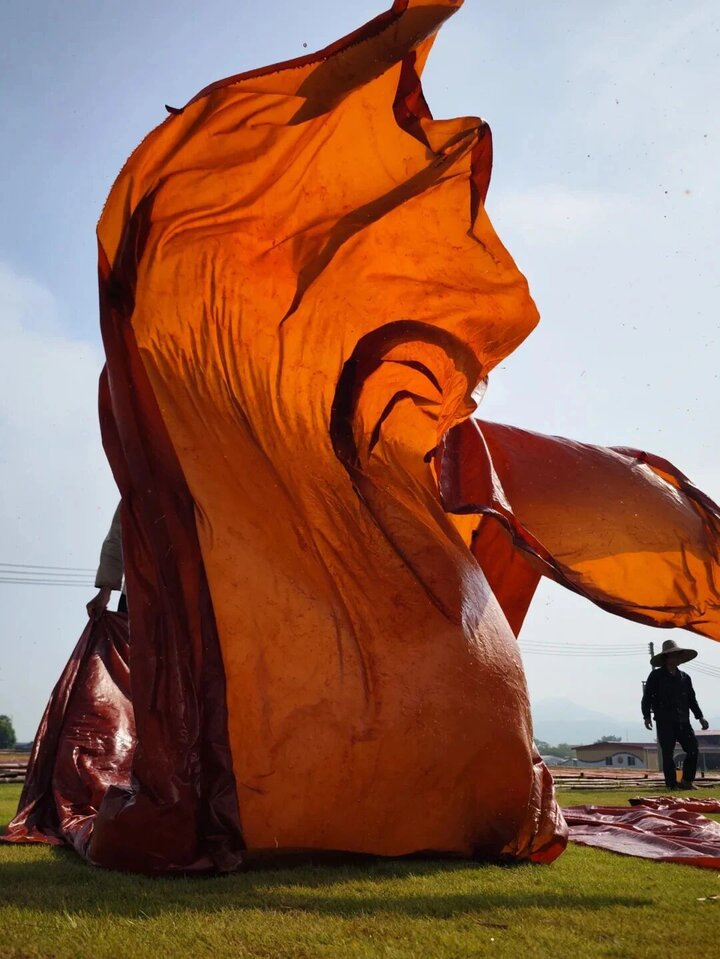
As the morning sun began to rise, the fields for drying Xiangyun yarn in places like Shunde, Nanhai, and Foshan in Guangdong were already bustling with the busy figures of workers.
Workers, wearing bamboo hats and bending over, gently and neatly lay down the dyed and finished pieces of Xiangyunsha, a traditional Chinese fabric, on the grass. The subtle fragrance of yam and the iron ions from the river mud waft through the air, marking the moment when this “soft gold” is undergoing solar drying.
Soaking, sealing, boiling, mud sealing, river washing, spreading fog… After “three steaming, nine boiling and eighteen drying“, through 14 processes and 36 procedures, the unique and wonderful texture of Xiangyunsha can be created.
Xiangyunsha is one of the world’s existing ancient, complex and legendary silk dyeing and finishing processes. It comes from the sunning fields in Lingnan, and the yarn and silk dyed and finished by its process have become the “golden clothes” that many Chinese people wear and cherish. At the same time, it has gradually moved from the sunning fields in rural Guangdong to the fashionable international stage like Paris, embarking on a new life of intangible cultural heritage that begins in the sunning fields and ends on the catwalk.
One is the sound of silk, the other is the fragrance of cloth.
01 Complex craftsmanship creates gold-like preciousness
In the field of silk fabrics, Xiangyunsha is known as “soft gold“.
Xiangyunsha is not a fabric, but a legendary dyeing and finishing technique. Its craftsmanship is a great creation that combines the wisdom of nature, local materials, and craftsmen. It is not simply a printing and dyeing process, but a deep collaboration with nature, a “co-creation between heaven and man”
The entire process of Xiangyun yarn craftsmanship includes up to 36 steps such as soaking, sun drying, sealing, boiling, mud washing, and water washing, all of which rely on manual labor and take at least one year to complete.
Its dyeing and sun drying have extreme requirements for weather, materials, and craftsmanship experience. The core process can be summarized as “three washes, nine boiling, and eighteen drying”, but this is only a relatively general estimate, and the actual production process and procedures are more complex.
Phase One: Raw Material Preparation – Derived from Natural Gifts
1. Preparation of raw fabric
The raw fabric is prepared to use high-quality mulberry silk and white plain silk, which requires uniform warp and weft density and no defects. It is usually a jacquard weave silk fabric (which is the traditional feeling of “yarn”) or plain weave silk.
2. Collect potato vines
Collecting potato vines is a unique wild vine plant in the Lingnan region, and its tubers are rich in components such as tannic acid, pectin, and red pigment, which are the key to staining. After the craftsmen go up the mountain to dig, they crush and soak it to obtain thick potato juice.
3. Mining and excavating river mud.
Not all river mud can be used for excavation, and it must be taken from specific unpolluted river depths in the Pearl River Delta region. This kind of river mud is rich in iron ions (usually divalent iron), with a delicate texture and a grayish black color. It is a “magic agent” that makes fragrant cloud gauze produce a dark and shiny surface.
Phase Two: Potato Robe Dyeing – Immersed in Sunlight and Time
This stage aims to allow silk to fully absorb tannic acid from yam, laying the foundation for subsequent reactions with river mud.
1. Guo Lang
Immerse the silk fabric completely into the juice of the potato vine and drag it repeatedly to ensure that each fiber absorbs the juice evenly.
2. Sun Lang
This is the most sun dependent step in the entire process. Spread the soaked silk flat on a dedicated lawn (sun drying area) of over 1000 square meters.
Grassroots can hold silk and provide just the right amount of moisture. Expose the fabric to ample sunlight in the hot summer, wait until it is completely dry, and then take it back for the next dip dyeing.
3. Boil and refine
Between multiple exposures, the fabric will also be briefly steamed in potato juice water to enhance its color fixing effect.
The cycle of “soaking, sun drying, and cooking” needs to be repeated dozens of times, depending on the desired color depth and fabric thickness. Every time it is immersed in sunlight and air, tannic acid undergoes oxidation and polymerization, gradually changing its color from light yellow to light red, deep red, and even reddish brown.
Phase Three: Crossing the River Mud – Wonderful Chemical Reactions
This is the most mysterious and crucial part of the entire process, usually carried out around dawn.
1. Go through mud
Apply river mud when crossing the river. Evenly apply the prepared and refined river mud onto the front of the fabric. The back (the side where the grass is pasted) maintains its original reddish brown color and does not come into contact with river mud. The application of mud requires extremely high skills and must be consistent in thickness.
2. Standing
After applying mud, let the fabric sit for about 1 hour. During this period, a magical chemical reaction quietly occurred: tannic acid in the potato vine fully combined with iron ions in the river mud, generating a new and extremely stable black precipitate – tannic acid iron. This is the fundamental reason why the front of Xiangyun yarn presents a black, shiny, and solid color.
Stage Four: Cleaning and Post finishing – Wash away the lead and leave it in its natural state
02. The miraculous creation of Lingnan scenery and wisdom
The dyeing process of Xiangyun yarn cannot be separated from the indispensable potato vine. According to literature records, there were already records of “potato vines” as early as the Tang Dynasty. Shen Kuo of the Northern Song Dynasty and Li Shizhen of the Ming Dynasty both described the dyeing effect of potato vines in their own works.
In the “Nanyue Notes” by Li Tiaoyuan of the Qing Dynasty, it is recorded that “potato vines produced in the north of the Yangtze River are good. Those that are white are not suitable for use, and those that are used must be red. Those that are red have a lot of gelatinous liquid, and fishermen use dyed gourds to make the taro hemp refreshing. It is not only good for water, but also resistant to salt and moisture, and not easy to rot.
The birth of Xiangyunsha cannot be separated from the natural and cultural environment of Lingnan region. Its history can be traced back to the Yongle period of the Ming Dynasty (around the 15th century), when Nanhai and Shunde in Guangdong were already famous sericulture towns.
Local fishermen have discovered through long-term labor that soaking fishing nets in potato vines (the root of a wild Lingnan plant) can make them tough and resistant to decay; Applying river mud to fabric can prevent moisture and insects. This folk wisdom was gradually applied to silk dyeing and finishing, thus forming the prototype of Xiangyun yarn craftsmanship.
During the Yongle period of the Ming Dynasty, Xiangyun yarn produced in Shunde, Guangdong had been exported overseas, and at that time, one piece of Xiangyun yarn could be sold for 12 taels of gold. From then on, Xiangyunsha gained the reputation of “soft gold” and “one or two pieces of gold, one or two pieces of yarn”.
By the mid Qing Dynasty, the craft of Xiangyun yarn had matured. According to the “Annals of Guangdong Province – Textile Industry Annals”, during the Qianlong period, there were already professional workshops for “Ransha Silk” in the Xiqiao area of Nanhai, Guangdong. Due to the light and cool texture of the finished fabric, which makes a “rustling” sound when walking, it was initially called “Xiangyun Sha” and later refined into “Xiangyun Sha”.
In 1915, Xiangyun yarn produced in Shunde won a gold medal at the Panama International Exposition. Once exported to Europe, America, India, South Asia and other places, it was praised by overseas people as the “shining black pearl” clothing, and Xiangyun yarn became a famous product of Chinese silk.