
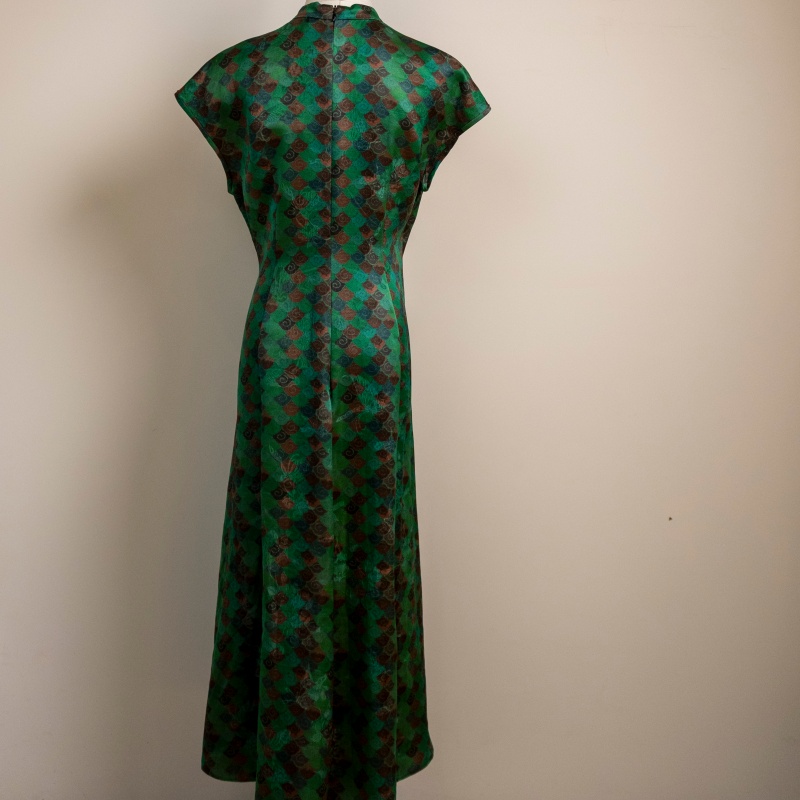
Short-sleeved silk cheongsam size selection
Short Silk Qipao Proportions and Size Selection: Finding the Right Balance for Your Body
A short qipao sits somewhere between a dress and a tunic. It ends above the knee, sometimes well above, and that change in length completely alters how the garment behaves on the body. What works for a floor-length qipao often fails miserably on a short one. The proportions shift, the drape changes, and the rules for choosing the right size become almost entirely different. If you have been wearing long qipao for years and are now trying a short version, expect to relearn a few things.
Why Short Qipao Proportions Are Trickier Than They Look
The length of a qipao is not just a number on a pattern. It changes the entire visual geometry. A long qipao elongates the body and hides a multitude of sins below the knee. A short qipao does the opposite — it exposes everything from the thigh down and draws the eye upward to the waist and bust. This means the proportions of the upper body become far more important than they are on a long version.
A short qipao also sits higher on the leg, which changes how the hem moves. The fabric has less distance to travel before it meets open air, so the drape is shorter and more dynamic. The hem swings more, flutters more, and clings more. All of this means you cannot simply take a long qipao pattern and chop off the bottom. The entire proportion needs to be rethought from the waist down.
The Upper Body Proportions That Matter Most
On a short qipao, the top half of the garment carries almost all the visual weight. Getting this right is everything.
Bust to Waist Ratio: The Defining Number
The difference between your bust measurement and your waist measurement is the single most important ratio for a short qipao. This number determines how much taper the garment needs, and taper is what gives a qipao its shape.
If your bust-to-waist difference is 20 cm or more, you have a dramatic hourglass. A short qipao will accentuate this beautifully, but you need to make sure the waist is not taken in too tightly. A tight waist on a short qipao can look disproportionate because the eye has nowhere to travel — it bounces right back up to the bust and gets stuck.
If your bust-to-waist difference is 15 cm or less, the silhouette is straighter. A short qipao on a straighter frame needs more structure in the bodice — deeper darts, more shaping — to create the illusion of a waist. Without that structure, the short qipao will hang like a tube and lose all its character.
Shoulder Width Relative to Hip Width
This ratio controls whether the short qipao looks balanced or top-heavy. If your shoulders are significantly wider than your hips, the garment will look like it is perched on your body rather than flowing from it. The fix is not to narrow the shoulders — that changes the entire construction. Instead, add 1 to 2 cm of width at the hem to create a slight A-line that balances the shoulder width visually.
If your hips are wider than your shoulders, the short qipao will naturally balance itself. The hem flares slightly over the hip, and the eye moves smoothly from shoulder to hip without any awkwardness. This is the easiest body type to dress in a short qipao.
Hem Length Selection: How Short Is Too Short
There is a sweet spot for short qipao hem length, and it depends on your leg length, not just your height.
The Mid-Thigh Hem: Bold and Dynamic
A hem that lands at the middle of the thigh is the most common short qipao length. It sits roughly 15 to 20 cm above the knee. This length shows the leg, creates a strong visual line from waist to thigh, and allows the hem to swing freely when you walk.
This length works best on frames where the thigh is relatively straight. If your thighs touch or rub together, a mid-thigh hem can create friction and make walking uncomfortable. The fabric has no room to move, and it will cling in all the wrong places.
For this length, the side slit should open to about 10 to 12 cm above the hem. Any higher and the slit starts to dominate the design. Any lower and you lose mobility.
The Above-Knee Hem: Playful and Modern
A hem that sits 5 to 8 cm above the knee is shorter and more daring. This length turns the qipao into something closer to a modern tunic. The drape is minimal — the fabric barely has time to fall before it ends.
This length demands lighter silk — ideally 14 to 16 momme. Heavier fabric at this length looks stiff and boxy. The whole point of an above-knee qipao is movement, and heavy silk kills that movement dead.
The proportions here also shift upward. The bodice needs to be slightly longer relative to the skirt portion to keep things from looking top-heavy. A good rule is to make the bodice 2 to 3 cm longer than you would on a mid-thigh version. This keeps the visual center of gravity lower and the look more balanced.
The Mini Qipao: When Short Becomes Extreme
A hem that lands at the upper thigh or just below the hip line is the mini qipao. This is not traditional by any stretch, but it exists, and it has its own set of rules.
At this length, the qipao is essentially a fitted top with a very short skirt. The proportions need to be almost square — the bust and hip measurements should be within 3 cm of each other. If there is too much difference, the garment will either gap at the waist or pull at the hips, and there is not enough fabric to hide either problem.
The hem at this length should have a wider opening — at least 8 to 10 cm — to allow any real movement. A narrow hem on a mini qipao looks decorative but functions like a straightjacket.
Choosing the Right Size: Why Your Usual Size Will Not Work
Here is something most people discover too late: your short qipao size is almost never the same as your long qipao size.
The Waist Needs to Be Looser, Not Tighter
Counterintuitive but true. On a long qipao, you want a snug waist because the length of the skirt balances it out. On a short qipao, a snug waist looks exaggerated because the eye has a short distance to travel. The waist should be 1 to 2 cm looser than your natural waist measurement. This creates a gentler taper that looks proportional on a shorter garment.
If you take the waist in too tightly on a short qipao, the hip area will flare out to compensate, and you end up with a bell shape instead of an hourglass. That is the opposite of what a qipao is supposed to do.
The Hip Measurement Gets More Generous
A short qipao needs slightly more room at the hip than a long one. Add 1 to 1.5 cm of ease to your hip measurement. This sounds like a lot, but remember — the skirt portion is short, so there is less fabric to distribute that ease across. The same amount of ease that disappears into a long skirt becomes very visible on a short one.
This extra ease also helps the hem swing. A tight hip on a short qipao freezes the hem in place. A slightly looser hip lets the fabric move, and that movement is what makes a short qipao look alive instead of stiff.
The Bust Darts Need Adjustment
On a long qipao, bust darts are deep and precise because the fabric has room to shape the bust over a long distance. On a short qipao, those same deep darts will create puckering because the fabric does not have enough length to accommodate the curve.
Reduce the dart depth by 3 to 5 mm compared to what you would use on a long version. The shaping still exists, but it is gentler. This prevents the fabric from pulling across the bust when you move your arms.
How Your Height Changes Everything
Height affects short qipao proportions more dramatically than it affects long ones.
Under 160 cm: Keep It Tighter and Shorter
If you are on the shorter side, a mid-thigh hem can actually make your legs look longer — but only if the hem is cut on a slight bias and the slit is positioned correctly. Avoid the above-knee length unless you have very straight, slim legs. A mini qipao on a short frame tends to overwhelm the body and make the torso look longer than it is.
Stick to a hem that lands no higher than 5 cm above the knee. Keep the proportions close to the body — do not add extra width at the hem, because that will visually shorten your legs even further.
Between 160 and 170 cm: The Sweet Spot
This height range can carry almost any short qipao length. The mid-thigh hem looks proportional. The above-knee hem looks playful without being extreme. Even the mini length works here because the legs are long enough to balance the short skirt.
The key is to match the hem length to your leg-to-torso ratio. If your legs are long relative to your torso, go shorter. If your torso is long relative to your legs, keep the hem at mid-thigh or just above the knee to avoid making the torso look even longer.
Over 170 cm: Length Gives You Freedom
Tall frames can carry a short qipao with confidence because the legs provide a long canvas that balances the short hem. A hem that lands at the mid-thigh on a tall person looks elegant and proportional. Even an above-knee hem works because the long legs prevent the look from becoming too top-heavy.
Taller wearers should not be afraid of wider hems at the bottom. The extra width creates a more dramatic swing and looks intentional rather than sloppy. A narrow hem on a tall frame can look like the qipao was cut too short by accident.
The Slit Position and How It Affects Proportions
On a short qipao, the slit is not just functional — it is a proportion tool.
Low Slit Creates a Longer Look
A slit that opens only 8 to 10 cm above the hem keeps the front of the qipao mostly closed. This creates a longer, more streamlined line from shoulder to hem. It works best on shorter frames or on qipao with a more conservative feel.
High Slit Creates a Wider Look
A slit that opens 15 cm or more above the hem draws the eye upward and outward. It makes the hips look wider and the waist look smaller by contrast. This is the best choice for frames where you want to emphasize the waist-to-hip ratio.
The slit width also matters. A narrow slit of 3 to 4 cm is elegant and subtle. A wider slit of 6 to 8 cm creates more movement and a more dramatic silhouette. On a short qipao, a wider slit tends to look more balanced because it gives the eye somewhere to go when the hem ends abruptly.
Fabric Weight and How It Changes Short Qipao Proportions
The same fabric behaves completely differently on a short qipao compared to a long one.
Light Silk Needs a Shorter Hem
Silk under 16 momme has almost no body. On a long qipao, this can work because the weight of the fabric accumulates over the full length. On a short qipao, light silk flutters, clings, and wrinkles at every movement. The solution is to go shorter — above the knee — so the fabric does not have time to misbehave. A mid-thigh hem in light silk will cling to your thighs and look like a slip, not a qipao.
Medium Silk Is the Most Forgiving
16 to 20 momme silk works across all short qipao lengths. It has enough body to hold its shape but enough softness to move naturally. This is the weight to choose if you are unsure. It behaves predictably, it photographs well, and it does not demand that you relearn your entire wardrobe to match it.
Heavy Silk Can Overwhelm a Short Length
Silk above 22 momme is beautiful but heavy. On a long qipao, the weight distributes evenly and creates that clean, architectural drape. On a short qipao, the same weight concentrates in a smaller area and can make the garment look stiff and boxy. If you love heavy silk, keep the hem at mid-thigh or longer to give the fabric room to behave. A mini qipao in heavy silk looks like armor, not clothing.