
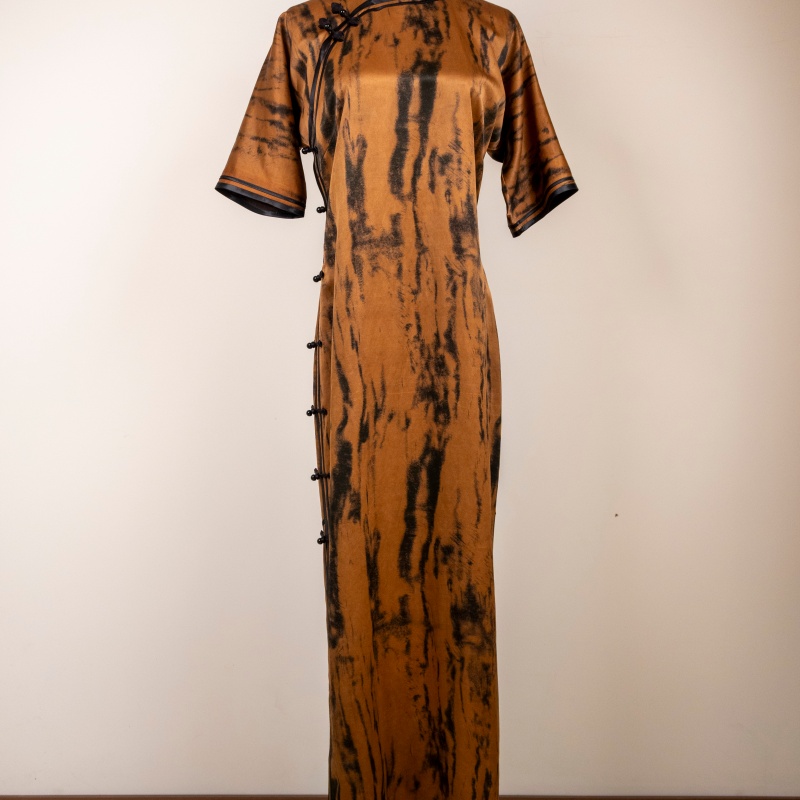
The drape of the silk cheongsam’s hemline and its overall appearance are well-matched.
Silk Qipao Hem Length and Drape: How to Match the Bottom Edge to Your Body and Fabric
The hem of a silk qipao is not just where the garment ends. It is where the entire silhouette makes its final statement. A hem that hangs too short chops the leg line. A hem that drags too long swallows the foot. And the drape — how the fabric falls from the hip to the floor — that is what separates a qipao that moves like water from one that moves like a curtain. Getting this right means understanding three things: hem length, fabric weight, and how they work together on your specific body.
Hem Length Basics: Where the Silk Should Actually End
There is no single “correct” hem length. There is only the correct hem length for you, your height, and the occasion. But there are guidelines that every maker follows, and knowing them helps you communicate what you need.
The Knee-Length Hem and When It Works
A hem that lands at or just above the knee is the most versatile starting point. It works on nearly every body type and suits both casual and formal settings. The fabric falls straight from the hip with minimal pooling, which means the drape stays clean and the silhouette stays sharp.
This length is ideal for medium-weight silk — the kind that has some body to it but still moves freely. If your silk is too light, a knee-length hem will flutter and cling to your legs in wind. If your silk is too heavy, it will bunch at the knee and look stiff.
For women under 160 cm tall, a knee-length hem can actually elongate the leg line if the hem is cut on a slight bias. For women over 170 cm, the same hem length can look slightly cropped unless the qipao has a side slit that adds visual length.
The Mid-Calf Hem and the Art of Controlled Pooling
A hem that reaches the mid-calf is where things get dramatic. This is the length most people picture when they think of a classic qipao — the one that sways when you walk and barely brushes the top of your shoe. The drape here is everything. The fabric needs to fall in a single, uninterrupted line from the hip to the floor without bunching, twisting, or clinging.
This length demands heavy-weight silk — at least 19 to 22 momme. Anything lighter will not have enough gravitational pull to create that smooth, vertical fall. The fabric will wrinkle, static-cling to your legs, and ruin the entire effect.
The mid-calf hem also requires a side slit. Without one, you cannot walk naturally. The slit should open to roughly 15 to 20 cm above the hem on the outer thigh. This lets the fabric part when you step forward and close when you stand still. It is functional and beautiful at the same time.
The Floor-Length Hem: Beautiful but Demanding
A hem that touches the floor is the most formal option. It creates a pooling effect where the silk gathers slightly at the feet. This looks stunning in photographs and on a runway, but it is the hardest to pull off in real life.
You need very heavy silk — 25 momme or more — for this to work. The fabric must be stiff enough to hold its shape while pooling but soft enough to move when you walk. This is a narrow window, and most silks do not hit it perfectly.
The floor-length hem also requires a taller wearer. If you are under 165 cm, the fabric will pile up around your feet and look messy rather than elegant. The hem needs room to pool, and short frames do not give it that room.
How Fabric Weight Controls the Drape
The hem does not exist in isolation. It is the final chapter of a story that starts with the fabric itself. The weight, the weave, and the finish of the silk all determine how the hem behaves.
Light Silk Falls Differently Than You Think
Silk under 16 momme is gorgeous but unforgiving at the hem. It has almost no body. It drifts, it clings, it wrinkles at the slightest movement. A hem cut from light silk will not hang straight — it will follow every contour of your leg, every breath of air, every shift of your weight.
This is not necessarily bad. Some designers actually want this effect — a soft, floating hem that moves with the body like a second skin. But it requires a shorter hem length to keep things under control. A floor-length hem in light silk looks like a costume, not a garment.
Medium Silk Is the Safe Middle Ground
16 to 22 momme silk gives you the most flexibility. It has enough weight to hang cleanly but enough softness to move naturally. The hem drapes without pooling excessively, and it works with lengths from knee to mid-calf.
This is the weight most handmade qipao use, and for good reason. It is forgiving during fitting, it photographs well, and it behaves predictably across different body types. If you are unsure what to ask for, start here.
Heavy Silk Commands the Hem
22 momme and above is where the hem becomes architectural. The fabric falls in a clean, vertical line. It does not flutter. It does not cling. It moves only when you move it, and then it moves with authority.
The downside is that heavy silk does not forgive bad cutting. If the hem is cut unevenly by even 3 mm, it shows. The weight of the fabric makes every imperfection visible. This is not a fabric for beginners — it demands a maker who understands how heavy silk behaves under a sewing machine.
Matching Hem Drape to Your Body Shape
The same hem length can look completely different on two different bodies. The secret is adjusting the drape to your proportions, not fighting against them.
For Curvy Hips: Let the Hem Breathe
If your hips are wider relative to your waist, the hem needs more volume than a straight-cut hem would suggest. A hem that is too narrow at the bottom will pull across the hip and create horizontal wrinkles. The fabric needs room to fall freely from the widest point of your hip to the floor.
Add 2 to 3 cm of extra width at the hem compared to the hip measurement. This sounds counterintuitive — you would think less fabric would be better — but the opposite is true. The extra width lets the silk fall straight instead of stretching taut across your curves.
For Slim Frames: Weight at the Hem Helps
If your frame is narrow with less hip volume, a hem that is too wide will overwhelm your silhouette. The fabric will billow and make you look smaller than you are. The fix is to use slightly heavier silk at the hem — some makers add a thin lining or a weighted hem band that gives the bottom edge just enough body to hang properly without adding bulk.
A knee-length or just-above-the-knee hem works best here. It keeps the visual weight balanced and prevents the fabric from swallowing your legs.
For Taller Wearers: Longer Hem, Sharper Drape
Height gives you more options. A mid-calf to floor-length hem works beautifully on taller frames because the fabric has more distance to develop its drape. The longer the fall, the more the silk can settle into that smooth, liquid line.
Taller wearers can also carry wider hems without looking overwhelmed. The proportions stay balanced because the vertical line of the body matches the vertical line of the falling fabric.
The Slit: How It Changes Everything About Your Hem
You cannot talk about hem drape without talking about the slit. The two are inseparable.
Slit Height and Hem Movement
A slit that opens too low — say, only 5 cm above the hem — restricts movement. You will feel the fabric pulling every time you take a step. A slit that opens too high — above the knee — changes the entire proportion of the qipao and can make it look like a dress rather than a qipao.
The sweet spot is 15 to 20 cm above the hem on the outer thigh. This lets the fabric part naturally when you walk while keeping the front of the qipao closed and elegant.
Slit Width Matters As Much As Height
A narrow slit of 3 to 4 cm is elegant but restrictive. A wider slit of 6 to 8 cm allows more movement and creates a more dramatic drape effect. The wider the slit, the more the hem fabric swings when you walk, and the more dynamic the silhouette becomes.
Match the slit width to the occasion. A narrow slit for formal events. A wider slit for evenings out or performances where movement is part of the look.
What Actually Happens When the Hem Is Wrong
A badly matched hem does not just look off — it changes how the entire qipao behaves.
If the hem is too short on heavy silk, the fabric bunches at the bottom and the drape line breaks. The qipao looks stubby and top-heavy. If the hem is too long on light silk, the fabric drags, wrinkles, and clings to your ankles. The drape line disappears entirely.
If the hem width does not match your hip volume, the fabric either pulls tight across the hip or sags below it. Both look wrong, and neither can be fixed with a simple hem adjustment. The cut itself needs to change.
The hem is the last thing a maker cuts and the first thing your eye sees when you walk. Spend time on it. Try the qipao on with shoes you actually plan to wear. Walk, sit, stand. Watch how the fabric moves from hip to floor. That movement — that drape — is what makes a silk qipao worth wearing.