
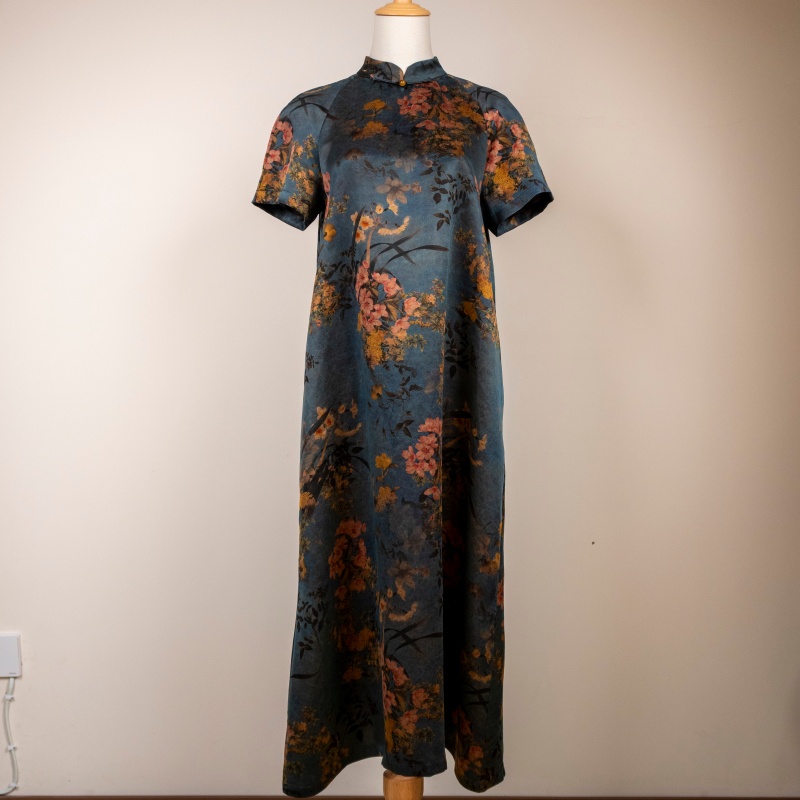
Judgment of the fitting degree of the collar of a handmade cheongsam
Handmade Qipao Collar Fit: How to Judge If Your Neckline Actually Fits
The collar of a qipao is the first thing people notice. It frames the face, defines the neck, and sets the tone for the entire garment. Yet it is also the part most likely to feel wrong when you try one on. Too tight and you cannot breathe. Too loose and it looks like you borrowed someone else’s dress. Getting the collar fit right is not about guessing — it is about measuring with your body and knowing exactly what to look for.
Breaking Down the Qipao Collar Structure Before You Judge Fit
You cannot judge fit if you do not understand what you are actually looking at. The qipao collar is not a single piece of fabric. It is a layered construction, and each layer behaves differently against your skin.
The Stand Collar Is the Hidden Framework
Most people focus on the visible outer collar — the rolled edge that sits against the neck. But the real structure lives underneath. The stand collar is a stiff, shaped inner piece that gives the outer collar its height and curve. It is usually reinforced with interfacing or even a thin layer of cardboard in handmade versions. When the collar feels too tight, the problem is almost always the stand, not the outer fabric. When it feels too loose, the stand may be too short.
The stand collar typically rises 3 to 4 cm above the neckline on a traditional high collar. On a lower rounded collar, it sits closer to 1.5 to 2 cm. These numbers matter because they tell you what to expect before you even put the garment on.
Collar Circumference Is Not the Same As Neck Circumference
Here is where most people get confused. The collar opening should not match your neck measurement exactly. It needs to be slightly smaller — roughly 0.5 to 1 cm less than your actual neck circumference. This is intentional. The collar needs to sit snugly against the skin without stretching. If you cut the collar opening to match your neck size, the fabric will sag within an hour of wearing.
The gap between the collar and your neck should be just enough to slide one finger between the fabric and your skin all the way around. No more. No less.
The Real Fit Tests: What to Do When You Actually Try It On
Forget the mirror for a moment. The best collar fit test happens with your body in motion.
The Swallow Test Tells You Everything
Swallow. Not once — three times. If the collar digs into your throat when you swallow, it is too tight. The stand collar is pressing into your windpipe, and no amount of “breaking it in” will fix that. A properly fitted collar should let you swallow freely, with the fabric moving slightly but never compressing.
If you feel the collar edge cut into the soft skin just below your jaw, the collar height is wrong. The stand is too tall, or the outer collar has been sewn too high on the stand. This is a construction error, not a fitting error, and it requires the collar to be unpicked and resewn at a lower position.
The Head-Turn Test Reveals Hidden Tension
Turn your head fully to the left. Then fully to the right. A well-fitted collar moves with you. It stretches slightly and returns to its shape. If the collar pulls sharply to one side, or if you feel the fabric binding at the back of your neck, the collar circumference is uneven. This usually means the stand collar was not cut symmetrically, or the seam allowances are inconsistent on the left and right sides.
You should also try tilting your chin down toward your chest. The collar should not choke you in this position. If it does, the front of the collar is too high relative to the back. The front edge needs to be lowered by 2 to 3 mm at most.
The Two-Finger Rule for Collar Tightness
Slide two fingers between the collar and your neck. If you can do this easily all the way around, the collar is too loose. If you can barely fit one finger, it is too tight. The sweet spot is one finger with slight resistance — you can slide it in, but it touches the fabric all the way around.
This test works best when you are standing upright, not leaning forward or looking down. Posture changes how the collar sits, and you want to judge it in a neutral position.
Common Collar Fit Problems and What They Actually Mean
Not every problem is obvious. Some fit issues only show up after you have worn the qipao for ten minutes.
The Collar Gapes Open at the Front
This is the most common complaint. You button the qipao, and the collar opens up at the throat like a flower. The cause is almost always one of two things: either the collar stand is too short, or the button placement is too low. When the pankou sits below the natural closing point of the collar, it pulls the entire neckline downward and creates a gap.
The fix is not to add more fabric to the collar. It is to raise the button by 3 to 5 mm or shorten the stand collar by the same amount. Sometimes both. A skilled tailor can fix this in under twenty minutes.
The Collar Feels Great Standing Still But Terrible When You Walk
This means the collar fits your neck at rest but fails under movement. The issue is usually the collar’s stiffness. A stand collar that is too rigid will not flex when you move your head, and it will dig into the same spot every time you turn. The solution is to replace the stiff interfacing inside the stand with a softer, more flexible material. This is not a size adjustment — it is a material adjustment.
One Side of the Collar Sits Higher Than the Other
This is a symmetry problem, not a size problem. The collar was likely sewn onto a stand that was not perfectly level, or the neckline curve was cut unevenly. When you try it on, one side will feel snug while the other feels loose. This cannot be fixed by taking in or letting out. The collar needs to be unpicked, the stand needs to be checked for evenness, and the whole thing needs to be resewn with careful attention to the center front alignment.
How Much Can You Actually Adjust the Collar Without Ruining It
The collar is the most delicate part of a handmade qipao. Every adjustment carries risk.
Lowering the Collar Height
You can lower the collar by up to 5 mm safely. Beyond that, the proportions of the entire neckline shift, and the collar starts to look like an afterthought. To lower it, unpick the outer collar from the stand, trim the stand by the desired amount, resew the outer collar, and press. The key is to keep the seam line clean — a messy seam on the collar is immediately visible.
Tightening a Loose Collar
Tightening is riskier than loosening. You can take in the collar opening by up to 5 mm total (about 2.5 mm per side). Any more and the collar will pucker when you button it. The take-in should happen at the side seams of the collar, never at the center front. Center front adjustments create visible pucker lines that no amount of pressing can hide.
When the Collar Simply Cannot Be Saved
Sometimes the collar is cut wrong from the start. If the stand collar is more than 8 mm too tall, or if the circumference is off by more than 1.5 cm, do not try to adjust it. The shape is compromised, and any fix will look like a patch job. In this case, the collar needs to be remade entirely. It is faster and cleaner to start over than to fight a badly cut collar.