
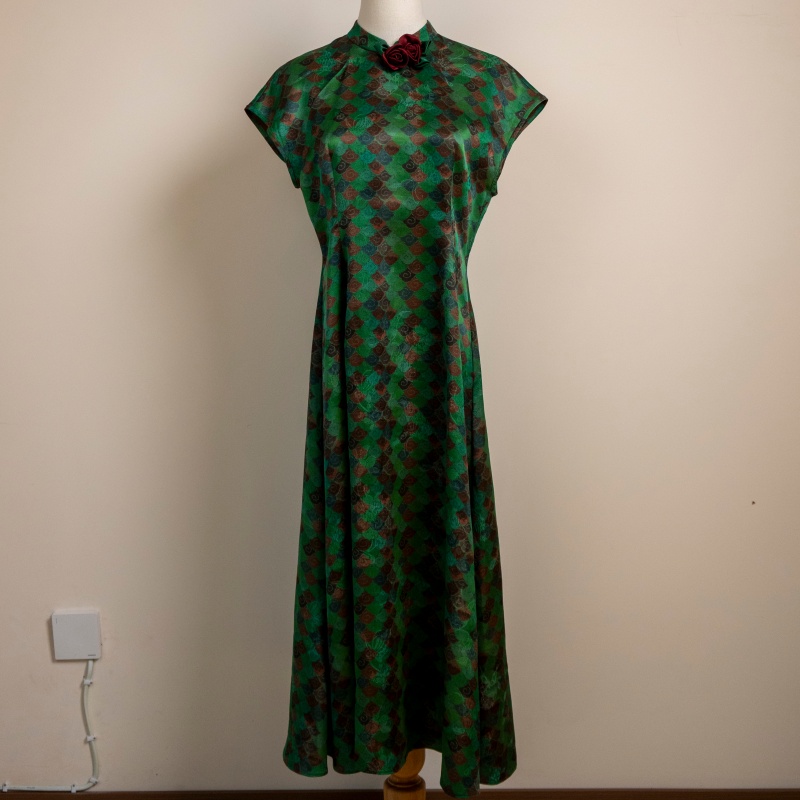
Silk cheongsam washing with cold water and temperature control
Silk Qipao Cold Water Washing: Why Temperature Control Is the One Thing You Cannot Get Wrong
Most people know silk needs cold water. That is the advice everyone gives. But nobody tells you what “cold” actually means, why a few degrees matter so much, or what happens when you get it slightly wrong. The result is a lot of guesswork — and a lot of ruined qipaos.
Temperature is not a minor detail when washing silk. It is the single most important variable in the entire cleaning process. Get it right and the fabric stays soft, the color holds, the shape survives. Get it wrong and you get shrinkage, stiffness, color bleeding, and permanent damage that no amount of care can reverse.
What “Cold Water” Actually Means for Silk
The term “cold water” is vague, and that vagueness is dangerous. Different people interpret it differently.
The Safe Temperature Range
For silk qipao, the ideal water temperature is between 15 and 20 degrees Celsius — roughly 59 to 68 degrees Fahrenheit. That is cooler than room temperature in most homes. If you run the tap and the water feels cool against the inside of your wrist, you are in the right zone. If it feels neutral or warm, it is too hot.
Anything above 25 degrees Celsius starts to risk fiber swelling. Above 30 degrees, you are actively damaging the protein structure. At 40 degrees and higher, silk begins to shrink almost immediately. The difference between 20 and 30 degrees might sound small, but on a protein fiber like silk, it is the difference between a clean qipao and a ruined one.
Why Room Temperature Water Is Not Cold Enough
This is where most people mess up. Room temperature water in a typical home sits around 22 to 25 degrees Celsius. That sounds cold. It is not. For silk, it is already in the danger zone.
Silk fibroin begins to soften and swell noticeably above 20 degrees. The sericin coating — the natural protective layer that gives silk its sheen — starts to break down. You will not see the damage right away. But after a few washes at room temperature, the fabric feels different. Slightly rougher. Slightly duller. The drape changes. That is the sericin stripping away, and it never comes back.
Ice Water Is Also a Bad Idea
Go the other direction and you run into a different problem. Water below 10 degrees Celsius can cause silk fibers to contract unevenly. This leads to water spots — faint, cloudy marks on the fabric that look like dried mineral deposits. They are actually areas where the fiber has tightened differently from the surrounding fabric.
Ice water also makes detergent less effective. Most neutral detergents are formulated to work best between 15 and 25 degrees. Below 15, the surfactants do not activate properly, which means the detergent sits on the surface instead of lifting dirt. You end up with a qipao that is technically “clean” but still has residue trapped in the weave.
Stick to 15 to 20 degrees. Not warmer. Not colder. That narrow window is where silk is happiest.
How Temperature Affects Different Parts of the Qipao
A qipao is not one uniform piece of fabric. It has seams, interfacing, embroidery, piping, and sometimes beading. Each of these reacts to water temperature differently.
The Main Body Fabric
Pure silk body fabric is the most temperature-sensitive part. It softens fast, swells fast, and shrinks fast. At 20 degrees, it is safe. At 25 degrees, it starts to lose its shape. At 30 degrees, you can expect measurable shrinkage — sometimes up to five percent in length, which on a fitted qipao is devastating.
The key is consistency. If you wash at 18 degrees every time, the fiber never experiences thermal shock. It stays stable. But if you wash once at 15 degrees and the next time at 25, the fiber expands and contracts unevenly, which weakens the weave over time.
Embroidered and Beaded Areas
Embroidery thread, beads, sequins, and appliques all have their own temperature tolerance — and it is usually lower than the fabric itself.
Silk embroidery thread swells at a different rate than the base fabric. When the temperature fluctuates, the thread and fabric expand at different speeds, which pulls stitches loose. Beads glued onto the surface can detach when the adhesive softens — and most bead adhesives start to weaken above 22 degrees.
This means the embroidered parts of your qipao need even colder water than the rest. Aim for 15 to 18 degrees in these areas. If you are doing a full qipao wash, use the lower end of the temperature range to protect every component equally.
Piping and Collar Interfacing
The piping along the edges and the interfacing inside the collar are often made from cotton or a cotton-blend. Cotton can handle warmer water — up to 30 or even 40 degrees without damage. But the silk next to it cannot.
If you use water that is warm enough for the cotton piping, you are overheating the silk. The result is a qipao where the piping looks fine but the adjacent silk has shrunk, puckered, or changed color. Always set the temperature for the most delicate component, not the sturdiest one. In a silk qipao, that is always the silk itself.
Practical Ways to Control Water Temperature at Home
You do not need a laboratory thermometer. But you do need a reliable method to make sure the water is in the safe range before you touch the qipao.
The Wrist Test Is Surprisingly Accurate
Run the tap into a basin. Dip the inside of your wrist into the water. If it feels cool but not cold — like a slightly chilled drink — you are around 18 to 20 degrees. If it feels like nothing, it is too warm. If it feels cold, it is probably below 15, which is fine but not ideal.
This method works because the inside of your wrist is one of the most temperature-sensitive parts of your body. It will tell you within a degree or two whether the water is safe.
Use a Kitchen Thermometer for Precision
If you want to be certain, a basic kitchen thermometer costs almost nothing and takes the guesswork out entirely. Drop it into the basin, wait thirty seconds, and read the number. If it is between 15 and 20, you are good to go. If it is above 22, add cold water or wait for the tap to cool down.
This is especially useful if you are doing a deep clean and need to fill a large basin. The water temperature can shift as you add more, and a thermometer catches that before you submerge the qipao.
Never Use the Washing Machine for Temperature Control
A washing machine cannot give you the precision a silk qipao needs. Even on a “cold” cycle, most machines heat the water to 20 to 30 degrees depending on the load, the season, and the machine’s calibration. Some machines add a hot water rinse even on delicate cycles.
The only safe way to wash a silk qipao is by hand, in a basin, with water you have measured or tested yourself. A machine is not worth the risk.
What Happens When the Temperature Goes Wrong
It helps to understand exactly what goes wrong so you take the temperature seriously.
Shrinkage Is Permanent and Uneven
Silk shrinks when heat causes the fiber to contract. The problem is that it does not shrink evenly. Areas under tension — like the side seams, the waist, and around the chest — shrink more than flat areas. This distorts the entire shape of the qipao. The waist pulls tight. The side slits become uneven. The fit that was perfect before washing is gone forever.
Even two degrees above the safe range can cause measurable shrinkage over multiple washes. It is cumulative. One wash at 25 degrees might not look bad. Five washes at 25 degrees will.
Color Bleeding Starts With Heat
Dye on silk is not as stable as dye on cotton. Heat opens up the fiber structure, which allows dye molecules to escape. This is why a qipao that looked fine after the first wash might look faded after the third. The color did not wash out all at once. It bled a little each time, and the heat accelerated it.
Cool water keeps the fiber closed and the dye locked in. This is why silk qipaos washed properly at 15 to 20 degrees can keep their original color for decades. The temperature is doing more for the color than any fancy detergent ever could.
Fiber Stiffness Is a Slow Killer
The sericin coating on silk is what gives it that soft, fluid drape. Heat strips sericin. Not all at once — gradually, with every wash. The first few washes at the wrong temperature, the qipao still feels fine. But by the tenth wash, the fabric has a noticeable stiffness. It does not flow the same way. It does not catch the light the same way.
This is irreversible. Once sericin is gone, it is gone. You cannot reapply it at home. The only way to prevent it is to keep every wash below 20 degrees, every single time.
Building a Temperature-Safe Washing Routine
Once you understand the numbers, the routine becomes simple.
Fill your basin with water. Test the temperature with your wrist or a thermometer. Add neutral pH liquid detergent — a few drops, not a pour. Submerge the qipao gently. Let it sit for three to five minutes. Do not agitate. Rinse twice with fresh cool water at the same temperature. Roll in a dry towel to remove moisture. Hang on a padded hanger in the shade.
The entire process takes fifteen minutes. The temperature check takes ten seconds. That ten seconds is what separates a qipao that lasts twenty years from one that falls apart after five washes.
Temperature is the one variable you control completely. Detergent brands come and go. Techniques get debated. But the water temperature is always in your hands — literally. Keep it between 15 and 20 degrees, and everything else falls into place.