
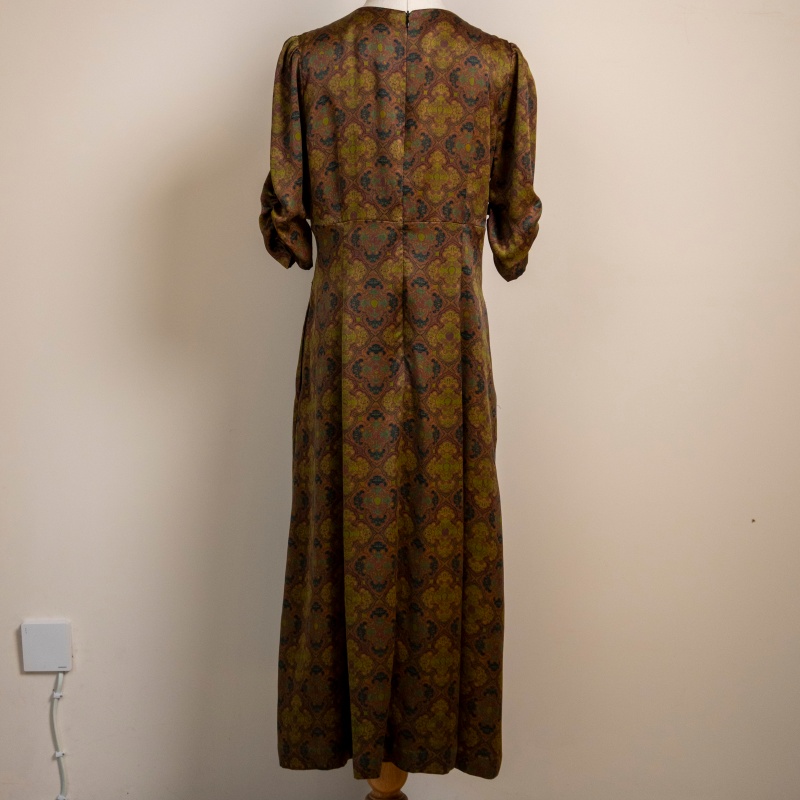
Handmade cheongsam should not be cleaned by vigorous rubbing.
Handmade Qipao Cleaning: Why You Should Never Rub It and What to Do Instead
There is a moment every qipao owner dreads. You pull the dress out of the closet, notice a stain, and your first instinct is to scrub it. Rub it hard. Work it with your fingers like you are washing a pair of jeans. That instinct is exactly what will destroy a handmade qipao in seconds.
Handmade qipao is not built to take friction. The fabric is thin. The stitching is delicate. The embroidery is raised. The frog buttons are hand-tied. Every element of the garment was designed to look beautiful, not to survive aggressive cleaning. The moment you rub it, you are fighting against everything the maker put into it.
The good news is you do not need to rub anything. Gentle handling cleans just as well — and keeps the qipao alive for decades.
What Rubbing Actually Does to Handmade Silk
Most people think rubbing removes dirt. On cotton towels and denim, that is true. On silk, it is the opposite. Rubbing pushes dirt deeper into the fiber, damages the surface, and distorts the shape. It does not clean. It destroys.
Friction Breaks Silk Fibers at a Microscopic Level
Silk is a protein fiber. When you rub it, the mechanical force pulls at individual filaments. Each stroke creates tiny breaks along the fiber surface. One rub does nothing visible. Ten rubs start to dull the sheen. Fifty rubs create pills — those little fuzz balls you see on old silk.
On a handmade qipao, this damage is irreversible. You cannot repair broken silk fibers at home. The only option is to prevent the breaks from happening in the first place. And the way to do that is simple: stop rubbing.
Agitation Lifts Embroidery and Loosens Stitches
A handmade qipao is not a flat piece of cloth. It has layers. Embroidery sits on top. Beads are glued on. Frog buttons are knotted by hand. When you rub the fabric, you are not just touching the surface. You are pulling at every raised element.
The embroidery thread lifts from the base fabric. The beads shift in their adhesive. The frog button knots loosen. The piping along the edges separates from the silk. None of this is visible after one rub. But after five or ten washes with aggressive handling, the embroidery starts to pucker, the beads fall off one by one, and the frog buttons dangle by a thread.
This is why handmade qipaos that have been “hand washed” sometimes look worse than ones that have never been washed. The washing itself was the problem.
Wringing Is the Fastest Way to Ruin the Shape
Wringing a qipao is like crumpling a piece of art. The bias cut — the diagonal weave that gives the qipao its body-hugging drape — cannot recover from being twisted. Once you wring it, the fabric distorts permanently. The waist pulls to one side. The side slits become uneven. The silhouette that fit perfectly before washing is gone.
Wringing also stretches the seams. Hand-stitched seams on a qipao are not as strong as machine-stitched ones. They were meant to look clean, not to hold up under tension. A hard wring can pop stitches along the side seams, the shoulder line, and the armholes. Repairing that requires a skilled hand — and it will never look exactly the same.
The No-Rub Cleaning Method That Works
If you cannot rub, cannot wring, and cannot agitate — how do you actually clean the thing? The answer is patience and the right technique. It takes longer than scrubbing, but it works every time.
The Press and Lift Technique
Instead of rubbing the stain, press it. Take a clean white cloth, dampen it with cool water and a few drops of neutral detergent. Place it flat against the stained area. Hold it there for ten to fifteen seconds. Lift it. Move to a fresh section of the cloth. Press again.
This is not scrubbing. You are not moving the cloth back and forth. You are pressing down and lifting up. The pressure pushes the dirt out of the fiber and into the cloth. The cloth absorbs it. You repeat with a clean section until no more dirt transfers.
For oil-based stains, add a drop of glycerin to the damp cloth before pressing. Glycerin breaks down oil without any friction. Press, lift, repeat. The oil comes out. The silk stays intact.
The Soak and Release Method
For a full qipao clean without any rubbing, use the soak and release method. Fill a basin with cool water — 15 to 20 degrees Celsius — and add a few drops of neutral pH liquid detergent. Stir gently until dissolved.
Lay the qipao flat in the water. Do not submerge it all at once. Lower it slowly, section by section, so the fabric does not bunch up. Once it is fully wet, let it sit for three to five minutes. Do not touch it. Do not move it. Just let the detergent work.
After the soak, lift the qipao straight out of the water. Do not wring it. Do not twist it. Hold it by the shoulders and let the water drip off naturally for thirty seconds. Then lay it flat on a dry towel, roll the towel up gently to absorb excess moisture, and unroll.
That is the entire process. No rubbing. No wringing. No agitation. Just patience.
Using Your Hands the Right Way
Sometimes you need to use your fingers — for the collar, the cuffs, or around frog buttons. The rule is simple: use the pads of your fingers, not your nails. Press with soft, flat contact. Never pinch, never twist, never pull.
For the collar area, place both thumbs on either side of the stain and press inward gently. For frog buttons, use your fingertip to dab the area around the knot — not the knot itself. For cuffs, curl your fingers around the fabric and squeeze softly, like you are holding a baby bird. Light pressure. Zero force.
Why People Rub in the First Place — and How to Break the Habit
Rubbing feels productive. It feels like you are doing something. But on silk, it is the least productive thing you can do. Understanding why you do it helps you stop.
The Cotton Mindset Does Not Apply Here
Everyone learns to wash clothes by washing cotton. Towels, t-shirts, jeans — all of them get rubbed, scrubbed, wrung. That works because cotton is a cellulose fiber. It is tough. It can take abuse.
Silk is not tough. It is a protein fiber, closer in structure to hair than to cotton. You would not rub your hair with a towel to clean it. You would not scrub your skin to remove a stain. Treat silk the same way. It deserves the same gentleness you give your own body.
The Urge to Rub Comes From Impatience
Most rubbing happens because people want fast results. They see a stain, they grab the fabric, and they scrub before they even think. The stain does not come out faster with more force. It comes out slower — because the force pushes it deeper.
Slow down. Press instead of rub. Wait instead of scrub. The detergent needs time to work. The water needs time to penetrate. Rushing the process with friction only makes it worse.
Trust the Detergent, Not Your Hands
Neutral pH liquid detergent is formulated to lift dirt from silk fibers without mechanical force. It does its job when you give it time and the right water temperature. Your hands are not the cleaning tool. The detergent is. Your job is to hold the fabric still and let the chemistry do the work.
Special Care for Heavily Decorated Areas
The more decoration a qipao has, the less it can handle rubbing. Embroidery, beading, sequins, and appliques all need extra gentleness.
Embroidered Sections Need Zero Contact
Do not touch embroidered areas with your hands at all during cleaning. The oils from your skin can discolor silk embroidery thread over time. Use a damp cloth to press the area gently from a distance — lay the cloth over the embroidery and press down, then lift.
If the embroidery has a stain, treat it the same way as the rest of the qipao: press, lift, repeat. Never scrub across the stitches. The thread will fray and the backing fabric will pucker.
Beads and Sequins Cannot Handle Any Friction
Beads are glued to the fabric. Sequins are sewn on with tiny stitches. Both will detach if you rub them. Clean around beads by pressing a damp cloth against the fabric next to the bead, not on the bead itself. Let the moisture seep under the bead and lift the dirt from the base fabric.
If a bead feels loose, do not pull it off. Leave it alone. A loose bead is better than a torn hole where the bead used to be. Take the qipao to a professional if beads start falling off — that means the adhesive has failed and needs professional reattachment.
Frog Buttons Require Fingertip-Only Contact
Frog buttons are the most frustrating part to clean because they are small, raised, and collect dirt in every crevice. But they are also the most fragile. Pulling on them to clean underneath will loosen the knots.
Use a damp cotton swab or a soft toothpick to reach into the gaps around each button. Dab gently. Do not pry. Do not pull. Work one button at a time, and rinse the swab frequently so you are not dragging dirt from one button to the next.
What to Do When a Stain Will Not Lift Without Rubbing
Sometimes a stain is stubborn. It does not respond to pressing. It does not lift with a simple soak. Your instinct says to scrub harder. Do not.
Increase Detergent Contact Time Instead of Force
If pressing is not working, leave the detergent on the stain longer. Apply a few drops of neutral detergent directly to the stain. Let it sit for ten to fifteen minutes instead of three to five. The extra time gives the detergent more opportunity to break down the stain without any added force.
Use Glycerin for Oil Stains That Resist Pressing
Glycerin is your best friend for stubborn oil stains on silk. It breaks down oil at a molecular level without any friction. Apply a small amount directly to the stain, let it sit for twenty minutes, then press with a damp cloth. The oil should lift easily.
Go to a Professional for Stains You Cannot Handle
If a stain does not respond to gentle pressing, longer soak time, or glycerin treatment, stop. Do not escalate to rubbing. Do not try bleach, vinegar, or ammonia on your own. Take the qipao to a cleaner who specializes in silk and handmade garments.
A professional has solvent-based cleaners and controlled steam equipment that can remove stubborn stains without any physical contact with the fabric. It costs more than a home clean. But it costs far less than replacing a handmade qipao.
The entire point of owning a handmade qipao is that someone spent hours making it by hand. Every stitch, every knot, every bead was placed with care. Rubbing it during cleaning undoes all of that work in minutes. The gentlest possible touch is not just a preference — it is the only way to respect what went into making the garment in the first place.