
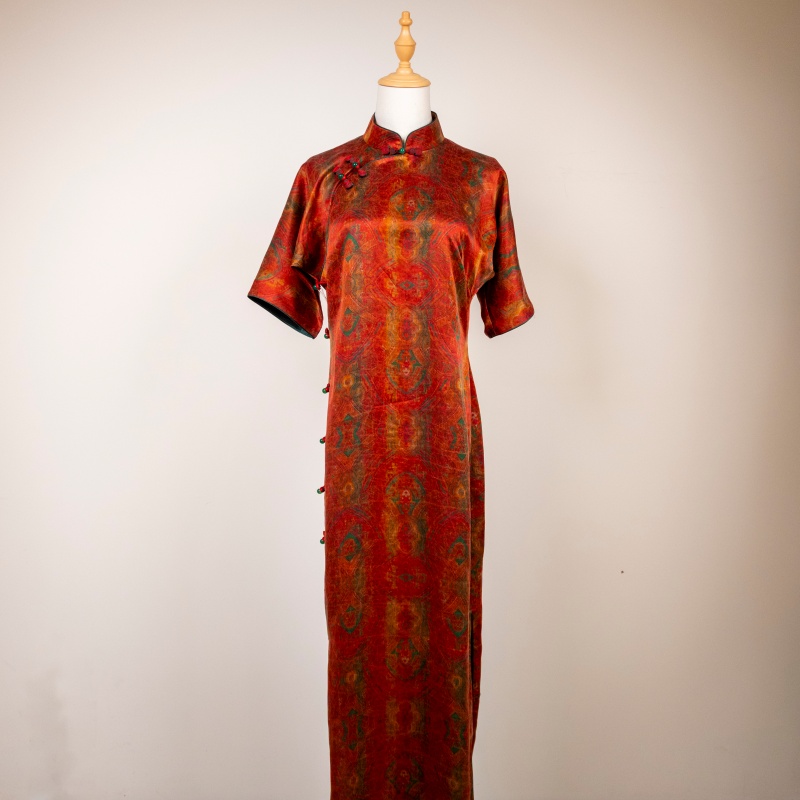
Handmade cheongsam drying method avoiding high temperature drying
How to Keep Your Handcrafted Cheongsam Away From High Heat Drying Without Ruining It
There is a moment after washing a handcrafted cheongsam when you just want it dry. Now. The sink is full of soapy water. You have plans tonight. The cheongsam is dripping on the bathroom floor. And that dryer sitting in the corner looks so easy.
Do not do it.
High heat is the fastest way to destroy a handcrafted cheongsam. Not slowly. Not gradually. In one cycle. The silk shrinks, the embroidery puckers, the beads crack, the shape collapses. What comes out of the dryer looks nothing like what went in. And you cannot get it back.
This is not about being careful. This is about understanding exactly what heat does to handcrafted silk and why no shortcut is worth the risk.
What High Heat Actually Does to Handcrafted Silk Cheongsam
The Fibers Shrink and Lock Into the Wrong Shape
Silk is a protein fiber. When it gets hot, the proteins contract. That contraction is permanent. A dry silk cheongsam can handle a brief warm iron. A wet silk cheongsam in a hot dryer? The fibers seize up, the weave tightens, and the whole garment shrinks by five to ten percent.
That shrinkage is not uniform. The seams shrink differently than the panels. The lining shrinks differently than the outer shell. The embroidery threads shrink at a different rate than the base silk. The result is a cheongsam that pulls at the seams, gaps at the buttons, and fits nothing like it did before the wash.
Once silk has heat-shrunk, there is no stretching it back. The fibers have re-bonded in a tighter configuration. You can iron it, you can steam it, you can soak it in vinegar for a week. The original dimensions are gone.
Embroidery and Beading Cannot Survive the Heat
The embroidery on a handcrafted cheongsam is the most heat-sensitive part of the entire garment. Silk embroidery threads are thinner than the base fabric and they carry sizing or wax coatings that melt at relatively low temperatures. When those coatings melt, the threads lose their structure and start to fray, tangle, and pull away from the base fabric.
Beads are worse. Glass beads can crack under thermal stress. Plastic beads warp and melt. Metal beads get hot enough to scorch the silk around them, leaving dark burn marks that never fade. Even wooden beads can split if the heat is uneven.
A cheongsam that goes into a dryer with beadwork comes out with broken beads, melted plastic, and scorched silk around every attachment point. The embroidery that took a skilled artisan weeks to complete is destroyed in forty minutes.
The Dye Bleeds and Fades Permanently
Heat opens up the silk fiber and releases dye molecules that would otherwise stay locked in place. In a hot dryer, the dye migrates unevenly. Some areas lose color. Other areas become darker where the dye has concentrated. The result is a patchy, inconsistent look that no amount of re-dyeing can fix because the original dye has already been altered at the molecular level.
Dark-colored cheongsam suffer the most. Black, navy, deep crimson — these shades show heat damage faster and more visibly than lighter colors. After one hot cycle, a black cheongsam can look more like dark gray with faded patches.
Why Every Common Drying Shortcut Fails
The Tumble Dryer Is Off Limits
This needs to be said plainly. A tumble dryer destroys handcrafted silk cheongsam. The combination of high heat, tumbling motion, and mechanical force is catastrophic. The heat shrinks the fibers. The tumbling stretches and distorts the shape. The mechanical force pulls at the embroidery and beads.
Even the lowest heat setting on most dryers is too hot for wet silk. Most dryers cycle between 40 and 60 degrees Celsius on their lowest setting. Wet silk starts to shrink at 35 degrees. You do not even have to be on the highest setting to cause damage. The lowest setting is still too much.
Do not put a handcrafted cheongsam in a dryer. Not once. Not on the lowest setting. Not in a mesh bag. Not for five minutes. The risk is not worth it.
The Hair Dryer Trick Is Worse Than You Think
Some people blow-dry their cheongsam with a hair dryer, thinking the airflow is gentle enough. It is not. A hair dryer concentrates heat on a small area and moves it across the fabric unevenly. The spots that get the most heat shrink first. The spots that get less heat stay wet longer. That mismatch creates permanent puckering and stiffness.
The directed airflow also pushes embroidery threads and beads out of position. A bead that takes ten seconds to shift under a hair dryer will stay shifted forever. The hair dryer method dries the cheongsam faster but ruins it in the process.
Radiators and Heating Vents Are Just as Dangerous
You would never put a cheongsam in a dryer, but you might drape it over a radiator or hold it near a heating vent. Same damage. The radiator surface can reach 70 to 80 degrees Celsius. That is well above the shrinkage threshold for wet silk. Holding a cheongsam near a vent subjects it to the same uneven heat distribution as a hair dryer.
The radiator method also dries one side of the cheongsam faster than the other. The side facing the radiator shrinks and stiffens. The side facing away stays damp. When the cheongsam finally dries, it is warped and stiff on one side, soft and damp on the other.
The Only Drying Methods That Do Not Use Heat
Shade Drying on a Flat Surface
The safest method for a handcrafted cheongsam is flat drying in the shade. Lay it face down on a clean dry towel. Smooth it out. Align the seams. Place rolled towels under any heavy embroidery or beaded areas for support. Leave it alone for 24 to 48 hours.
This method uses zero heat. The moisture evaporates slowly at room temperature. The shape stays locked because gravity pulls evenly across the entire surface. The embroidery dries at the same rate as the base fabric because nothing is pressing down on it.
It takes patience. It takes a large dry surface. It takes the discipline not to touch it for two days. But it is the only method that guarantees zero heat damage.
Hanging in the Shade With the Right Setup
If you must hang the cheongsam to dry, use a wide padded hanger covered in cotton. Clip the hanger to the side seams, not the shoulders. Hang it in the darkest, coolest spot available with gentle indirect airflow.
The side-seam clipping takes the weight off the shoulders and prevents stretching. The padded hanger distributes the load evenly. The shade protects the color. The airflow speeds evaporation without adding heat.
Only hang a cheongsam that is at least 70 percent dry. A soaking wet cheongsam on a hanger will stretch permanently within hours. Do the towel-roll first, let it drain, then hang it for the final drying phase.
Using a Dehumidifier Instead of Heat
A dehumidifier removes moisture from the air, which speeds up evaporation without raising the temperature. This is the closest thing to a safe shortcut. Set the dehumidifier to 45 to 50 percent relative humidity. Place it in the same room as the cheongsam, at least one meter away. Run it continuously until the cheongsam is fully dry.
With a dehumidifier, a handcrafted cheongsam can dry in 12 to 18 hours instead of 24 to 48. That is a significant time save with zero heat exposure. The dehumidifier does the work that heat would do, but without any of the damage.
Protecting Embroidery and Beading During Non-Heat Drying
The Tissue Paper Barrier Method
For cheongsam with raised embroidery, place a sheet of unbleached tissue paper over the motif before laying it flat to dry. The paper prevents the beads and thick threads from pressing into the wet silk and leaving permanent indentations.
Remove the paper after six to eight hours. Leaving it on too long traps moisture under the paper and slows drying in those areas, which invites mildew on the embroidery threads.
Supporting Heavy Areas From Below
Beads and dense embroidery add weight. When the cheongsam is wet, that weight pulls the fabric downward and creates permanent sags. Place rolled towels underneath every heavy area before you start drying. The collar, the front placket, the side slits — all of them need support.
Check the rolled towels every few hours. As the cheongsam dries and gets lighter, you can remove the support gradually. By the time it reaches 80 percent dryness, the beads no longer need it.
Turning Inside Out Before Drying
Always dry the cheongsam with the inner lining facing out. The outer surface carries the dye and the sheen. Exposing it to even filtered light during drying accelerates fading. The lining side is more forgiving and dries at a similar rate, which helps balance the drying process between the two layers.
Flip it inside out before you lay it on the towel or hang it on the hanger. Keep it that way until it is completely dry. Flip it back only when you are ready to store or wear it.
How to Tell If Your Cheongsam Survived the Drying Process
Touch the lining first. Not the outer surface. The lining dries last because it sits against the body of the fabric and traps moisture. If the lining feels even slightly damp, the cheongsam is not ready.
Check every embroidered section. Run your fingers over each motif. The threads should feel smooth, not stiff. The beads should sit flat, not tilted. If any thread feels rough or any bead has shifted, that area dried unevenly.
Smell the lining. No musty odor. No sourness. No earthiness. If it smells like clean fabric — like nothing — it is dry. If it smells like anything other than clean fabric, keep drying.
A handcrafted cheongsam that avoids high heat drying will look and feel the same ten years from now as it does today. The embroidery stays intact. The beads stay in place. The color stays sharp. The shape stays true. That is what patience buys you. Not speed. Not convenience. Just a garment that lasts.