
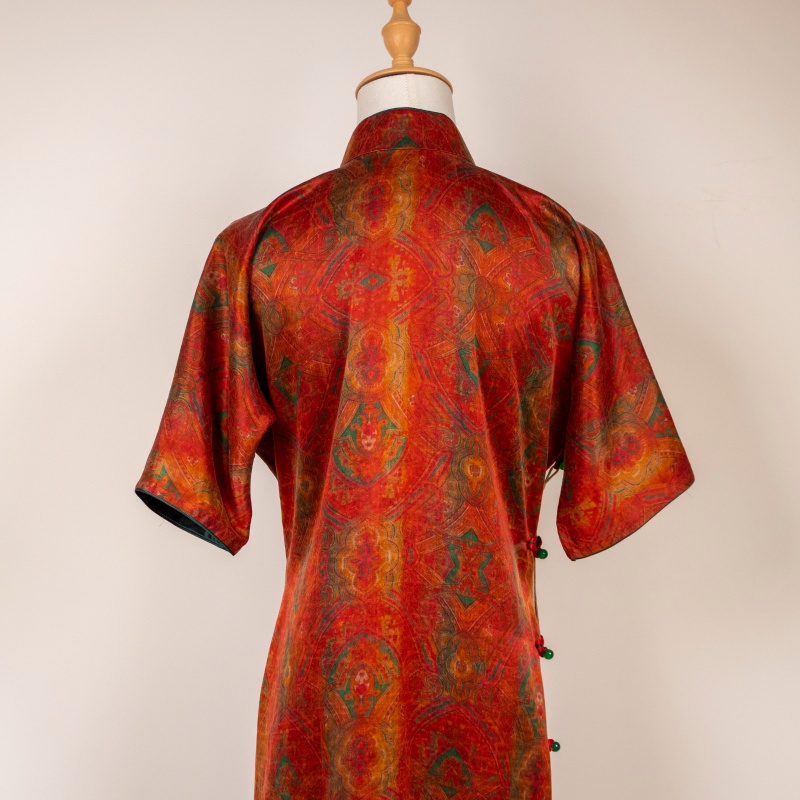
The criteria for determining when a handmade cheongsam is completely dry
How to Tell If Your Handcrafted Cheongsam Is Actually Dry Before You Put It Away
You washed your handcrafted cheongsam. You laid it flat. You waited. You think it is dry. You fold it up and put it in the closet. Two weeks later, you pull it out and there is a faint yellow stain on the lining. A musty smell. The embroidery threads have gone stiff. Mildew has set in.
The cheongsam was not dry. You thought it was. But it was not.
Judging dryness by look and feel is the most common mistake people make with silk cheongsam. The outer surface can look and feel completely dry while the lining is still damp. The embroidery can feel dry while the threads underneath are holding moisture. By the time you notice the damage, it is already done.
Knowing exactly how to check for dryness — and checking the right spots in the right order — is the difference between a cheongsam that lasts decades and one that falls apart after a few washes.
Why the Outer Surface Lies to You
Dry-Looking Does Not Mean Dry
Silk dries from the outside in. The outer surface loses its moisture first because it is exposed to air. Within a few hours, the outer fabric looks matte instead of shiny. It feels smooth instead of slick. It seems dry.
But the inner lining is a different story. The lining sits against the outer fabric and traps moisture between the two layers. Air cannot reach it easily. In a still room, that trapped moisture can take twice as long to evaporate as the outer surface.
So you touch the outside. It feels dry. You fold it up. You store it. And the lining, still damp, starts to mildew inside the fold. By the time you smell it, the damage is already deep in the fiber.
Embroidery Dries at a Different Rate Than the Base Fabric
Embroidery threads — especially silk and rayon ones — are thicker and denser than the base silk. They absorb more water and release it more slowly. A cheongsam with heavy embroidery can have dry base fabric and still-damp embroidery threads at the same time.
This mismatch creates tension. The dry base fabric pulls tight while the wet embroidery resists. The result is puckering around every stitched section. Once that puckering dries in, it is permanent. No iron, no steamer, no amount of pulling can flatten it back out.
You cannot tell this by looking at the cheongsam from across the room. You have to touch the embroidery threads directly. Every single one.
The Only Reliable Way to Check Dryness
Touch the Lining First, Not the Outside
The lining is the last part of any cheongsam to dry. It is also the most important part to check. If the lining is even slightly damp, the cheongsam is not ready.
Reach inside the garment. Touch the lining fabric near the waist and under the arms. These are the areas that hold moisture the longest because they are farthest from the air and closest to the body of the fabric.
The lining should feel cool, smooth, and completely dry. Not cool and slightly damp. Not cool and barely moist. Completely dry. If you feel any moisture at all — even a tiny bit of dampness — the cheongsam needs more drying time.
Check the Seams Next
Run your fingers along every seam. The side seams, the shoulder seams, the collar seam, the hem seam. Seams are where two pieces of fabric overlap, and that overlap creates a pocket where moisture can hide.
A dry seam feels flat and smooth. A damp seam feels slightly cool and has a faint softness that dry fabric does not have. If any seam feels even slightly damp, the cheongsam is not fully dry.
Pay special attention to the side slits. The slits are cut into the fabric and the raw edges trap moisture. They take longer to dry than any other part of the cheongsam. If the slits are damp, everything else is probably damp too.
Feel the Embroidery Threads One by One
This is the step most people skip. They glance at the embroidery, see that it looks dry, and move on. That is a mistake.
Run your fingertips over every embroidered section. The threads should feel smooth and dry. If any thread feels stiff, rough, or slightly cool to the touch, that area is still holding moisture. Stiff embroidery threads are a sign of uneven drying. The thread dried too fast while the base fabric was still wet, or the thread is still wet and drying unevenly.
For cheongsam with beadwork, check around each bead. Run your finger along the thread that holds the bead to the fabric. If that thread feels damp, the bead area is not dry. Beads trap moisture underneath them and slow drying in those spots significantly.
The Time-Based Dryness Check
Minimum Drying Times by Method
Flat drying in a shaded room at room temperature: 24 to 48 hours for plain silk. 36 to 72 hours for embroidered cheongsam.
Hanging in the shade with a padded hanger: 18 to 36 hours for plain silk. 24 to 48 hours for embroidered cheongsam.
Using a dehumidifier: 12 to 18 hours for plain silk. 18 to 24 hours for embroidered cheongsam.
These are minimums. Not averages. If your cheongsam has heavy beadwork or dense embroidery, add 12 to 24 hours to whatever method you are using.
The Six-Hour Checkpoint
At the six-hour mark, do not flip the cheongsam. Do not adjust it. Just touch the lining through the fabric. If the lining feels even slightly cool, it is not ready.
At the twelve-hour mark, check the seams and the embroidery. If any area feels damp, keep drying.
At the twenty-four-hour mark, do the full check. Lining, seams, embroidery, beads. If everything passes, the cheongsam is dry. If anything fails, keep going.
Why Rushing the Checkpoint Causes Damage
Most mildew damage happens because people check too early and declare the cheongsam dry when it is not. The six-hour mark is not a finish line. It is a checkpoint. The cheongsam will still be 60 to 70 percent wet at six hours. That is normal.
Do not speed up the process by moving the cheongsam to a warmer spot or increasing airflow. Uneven drying causes more damage than slow drying. A cheongsam that dries slowly and evenly will always be in better shape than one that dries fast and unevenly.
The Smell Test and What It Actually Means
Clean Smell Means Dry, Musty Smell Means Trouble
Lift the cheongsam and smell the lining. A fully dry cheongsam smells like nothing. Clean fabric. No odor. If it smells like anything — musty, sour, earthy, damp — it is not dry.
Mildew does not wait until the cheongsam is visibly wet to start growing. It begins the moment moisture sits in the fiber for too long. The smell is the first warning sign. If you smell it, mildew has already started.
At the first sign of smell, move the cheongsam to a drier spot immediately. Increase dehumidifier output. Add fresh silica gel packets around the garment. The earlier you catch it, the easier it is to reverse.
Do Not Confuse Vinegar Smell With Mildew
If you used a vinegar rinse during the final wash, the cheongsam will have a faint vinegar smell even when dry. That is normal. Vinegar smell is sharp and acidic. Mildew smell is earthy and musty. They are completely different.
If you are not sure, sniff the lining away from your face. A quick sniff from a distance will tell you if the smell is vinegar or mildew. Vinegar dissipates quickly. Mildew lingers.
The Physical Signs That Dryness Is Fake
Stiffness Is a Red Flag, Not a Good Sign
Some people think a stiff cheongsam means it is dry. It does not. Stiffness means the fibers dried too fast and locked up. A cheongsam that is truly dry should feel soft and supple, not rigid.
If the cheongsam feels stiff after what you thought was a full drying cycle, it probably dried unevenly. The outer surface locked up before the inside was dry. The stiffness is a sign that the drying process went wrong, not that it is finished.
Keep drying a stiff cheongsam. It is not done.
Wrinkles That Do Not Smooth Out Mean Trapped Moisture
If the cheongsam has wrinkles that do not release when you touch them, there is still moisture trapped in the fibers. Dry silk releases wrinkles easily when you smooth it with your hand. Damp silk holds creases because the water keeps the fibers in a rigid state.
Smooth the cheongsam out completely. Wait ten minutes. Check again. If the wrinkles are back, the fabric is still damp. Keep drying.
Color That Looks Dull Means Incomplete Drying
Wet silk looks darker than dry silk. As the fabric dries, the color deepens and the sheen returns. If the cheongsam looks dull or flat after what you thought was a full drying cycle, it is probably still slightly damp.
Hold the cheongsam up to a light source. The dry areas should have a soft sheen. The damp areas will look matte. If you see any matte patches, those areas need more time.
The Final Check Before Storage
The Three-Point Confirmation
Before you fold or hang the cheongsam, confirm all three points.
First, touch the lining. It must be completely dry. No cool spots. No damp areas. No moisture of any kind.
Second, check every seam and every embroidered section. All must feel dry and smooth. No stiffness. No roughness. No cool spots.
Third, smell the lining. No musty odor. No sourness. No earthiness. Just clean fabric smell or nothing at all.
If all three pass, the cheongsam is dry. If even one fails, keep drying.
Why You Should Never Store a Cheongsam You Are Not Sure About
A cheongsam stored while even slightly damp will develop mildew within a week. The smell becomes permanent. The yellow stains do not come out. The embroidery threads weaken and may snap. The shape distorts as the fabric warps under the weight of trapped moisture.
It takes an extra twelve hours to be certain. It takes weeks to fix the damage if you guess wrong. The extra drying time is not a waste. It is an investment in the garment.
The Storage Setup That Protects a Dry Cheongsam
Once you confirm full dryness, store the cheongsam inside out in a breathable cotton wrap. Not plastic. Plastic traps any residual moisture and creates a microclimate where mildew thrives even in a dry garment.
Place the cotton-wrapped cheongsam in a cool, dark closet. Add fresh silica gel packets inside the wrap. Check the cheongsam every three months. Touch the lining. Smell the fabric. If everything is still dry, leave it alone. If you detect any dampness, take it out and re-dry it immediately.
A handcrafted cheongsam that is dried properly and stored correctly will look and feel the same ten years from now as it does today. The embroidery stays intact. The beads stay in place. The color stays sharp. The shape stays true. All of that starts with knowing exactly when the cheongsam is dry — and not guessing.